Showing posts with label William Parker. Show all posts

Wednesday, January 21, 2009

One Hell of an Overdue William Parker Review

As far as I can tell, I've been promising a review of William Parker's "Petit Oiseau" for at least three months. You're just going to have to take my word for it, though, that I have been incredibly, horrifically, hell, excruciatingly busy recently. As some of you know, I am a staff writer for the Berklee College of Music newspaper, The Groove, in addition to my responsibilities as a broke college student whose sources of income do not include amongst themselves "snarky jazz-blogging asshole." I do, however, keep up with the music (I can even get it for free now that I have two different papers I can use for credentials!), and whenever possible I plan on continuing to write reviews of new jazz albums and general nastiness about the jazz press (get excited for next time when I go through the Jazz Times Top 50, which includes Joe Lovano's syrupy "Symphonica" as the second best album of the year).

No one can accuse William Parker of being stingy or of allowing himself to sink into obscurity while other, younger free jazz musicians get all of the acclaim; he has appeared in a feature in Downbeat (remember the last time Downbeat had a feature article about a contemporary free jazz musician who wasn't young and sexy like Nicole Mitchell? Oh yeah, never) and has released two records a year since 2005. That said, however, Parker's recent outpouring of creativity has come at the expense of regular dates with his quartet, one of the best units in jazz. The last date, 2005's "Sound Unity," was the third part in a trilogy of sorts that included 2000's game-changing "O'Neal's Porch" and 2002's "Raining On the Moon." All three albums featured the trio playing lyrical free jazz in the OCDC ("Ornette Coleman Don Cherry") vein- the music was as melodic as any straight-ahead jazz but with enough craziness courtesy of saxophonist Rob Brown and Trumpeter Lewis Barnes that it retained its edge.

Those three records were all about the frontline, Barnes and Brown, coming up with crazy melodies. "Petit Oiseau" is all about the rhythm section, which in addition to Parker includes drummer and long-time co-conspirator Hamid Drake. The comparison's to Coleman's classic late-50s quartet are still relevant, of course, but by now Parker and Drake have been playing together for so long that they sound telepathic in comparison to Coleman's alternatingly madcap and pensive rhythm section of Charlie Haden and Billy Higgins. Besides, Parker is more interested in making his music funky: imagine an entire record of variations of the rhythm section part to Coleman's "Ramblin'" and you begin to get the idea. The grooves on tracks like "Grove Suite" and "The Golden Ball" recall funky world music, but with a looseness only heard in free jazz.

Of course, even though the focus has shifted a bit, Parker's horn players sound as good here as they do on his other records. Rob Brown's saxophone playing is rivaled in ferocity only by Rudresh Mahanthappa's, and on this album it is like an explosion in the center of Parker and Drake's grooves. Barnes, on the other hand, floats over the proceedings like the hummingbird on the album's cover. Together they make up the yin and yang in Parker's music; sometimes sweet, sometimes sour. On an uptempo number like "Four for Tommy," the difference in style becomes readily apparent: Barnes is interested in making music out of sheer sound, while Brown creates odd melodic and harmonic linear statements out of thin air.

Sunday, September 28, 2008

Not Exactly A Free Jazz Round-Up

I know; I promised a round up of new free jazz recordings, and that was what I was initially planning on writing about. But then I heard Joel Harrison's "The Wheel," one of those albums that I've put off listening to forever; it's good, and it wasn't what I was expecting. Generally, when I hear "jazz with strings" without the words "Bill Frisell" and/or "Jenny Scheinman" (or, I suppose, "Anat Cohen") nearby, I cower away and put on "Esperanza" or "The Bird and the Bee" or whatever other catchy, unpretentious album I have nearby that I don't have to feel bad about listening to. Of course, "The Wheel" has nothing in common with the other album I'd like to talk about, "Beyond Quantum," which is a collaboration between saxophonist Anthony Braxton, drummer Milford Graves and bassist William Parker.

Joel Harrison's "The Wheel" is a collaboration between Harrison's jazz quintet (Harrison on guitar, David Binney on alto, Ralph Alessi on trumpet, Lindsey Horner on bass and Dan Weiss on drums) and a string quartet (Todd Reynolds and Christian Howes on violin, Caleb Burns on viola and Wendy Sutter on cello). It is not, however, a series of songs written for jazz quintet with string arrangements; the quartet is fully integrated in the band. Like Jenny Scheinman's recent "Crossing the Field" and Bill Frisell's "History Mystery," the feel is more rural-jazz than third-stream, as the strings improvise along with the rest of the band and the proceedings are given over to music reminiscent of Copland and folk melodies. The final track, "In Memorium: Dana Breyton," features Harrison's guitar, and his solo is characterized by long-held tones and beautiful phrasing. Recommended.

It's almost hard to believe that Anthony Braxton, William Parker and Milford Graves have never played together in a trio before "Beyond Quantum." In addition to the fact of both Braxton and Parker's prolificness, the album simply sounds like it was made by people who have been playing together forever. Braxton's snaky, staccato attack creates a polar contrast to Parker's melodic approach to his bass playing, and Graves serves as the level headed one; a moderator for the arguments that the other two carry out. Braxton plays four separate saxophones (I know the four types that you're thinking of- you've probably only got one right), and his approach to each instrument is slightly different, but equally violent. His bass saxophone plods, crushing everything around it, while his sopranino attacks like one of the namesakes of Hitchcock's "The Birds." Recommended for those who like a little bit of psychotic energy with their free jazz.

Next time I will probably post a conversation with Terri Lyne Carrington, who I will be interviewing for the Berklee Groove tomorrow morning. You can expect a more sanitized version of that published in the next issue of The Groove. Also, tomorrow night I will be doing the first of what will be a bi-weekly segment for my friend James Krivchenia's show "Switch it Up" at 12 AM (as in, at night) on the Berklee Internet Radio Network

Saturday, September 20, 2008

Two Good Downbeats? In One Year? Naaahhh...

It's true. Although it isn't quite as good as the Vijay Iyer-Jason Moran-Matthew Shipp cover which featured Jenny Scheinman and Kurt Rosenwinkel, the new Downbeat is absolutely killer. Can you remember the last time (discounting that issue, of course) that Downbeat managed to run feature articles on three real-live interesting musicians? Musicians whose music could actually be qualified as experimental? And this time the didn't even temper Bill Frisell's all-inclusive nature by calling him the Wynton Marsalis of, I dunno, Seattle. The other main articles are about William Parker (a free jazz musician!) and Tomasz Stanko (a EUROPEAN (occasional) free jazz musician!).

But, as always, the best section is the "Players" section (not to be confused with the "Playaz" section- originally created for Miles Davis); this time around it features my favorite young trumpet player at the moment, Mathias Eick. As much as I love Christian Scott and Ambrose Akinmusire, Eick is the only young musician (period.) who has anything approaching tact in his playing. And then, of course, there are the extremely interesting musicians that I'd never heard of that I am presently listening to (harpist Edmar Castaneda and Anne Mette Iversen in this issue). In all honesty, I occasionally wish that Downbeat were simply a 90 page "Players" section.

Granted, though, if it were I wouldn't be able to gripe about Downbeat's occasional faux pas. There was one I could find in this issue, and in all honesty it's pretty small and most people will not notice it. However, in spite of that, it is a huge faux pas. In a review of "In Sweden: November 22, 1950," critic John McDonough writes that "after a prolific 65-year recording career, [Arne Domnerus] remains active today at 83." Those of you who read this blog are aware of the fact that Domnerus is dead. Granted, he probably died after Downbeat went to press. But still.

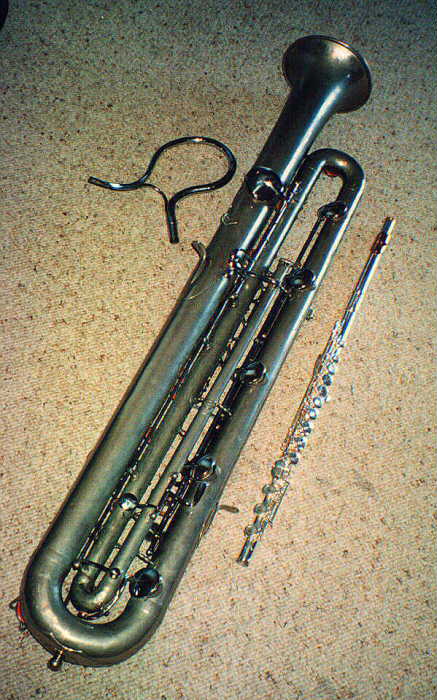
Also, in a random sidenote: would I be correct in saying that the contrabass sarrusophone is making a come-back in jazz in a big way? I saw not just one, but two references to the absurdly obscure, gigantic behemoth of a double-reed instrument in this issue. I'm almost tempted to turn it into a Where's Waldo style contest for you readers out there, but I'll give them away: James Carter owns two (TWO!!!! WHERE DOES HE FIT THEM?) of them, and Scott Robinson apparently plays one on his new record, "Forever Lasting" (HOW DO YOU PLAY IT?!).

Next time I'll have a round-up of some recent free-jazz recordings, including the new CD from the Anthony Braxton-Milford Graves-William Parker axis.